Home
學生控制台
註冊會員/登入
研究知情同意書
UeduGPTs
Aida 優學伴
Uedu Open
支援與訊息

UeduGPTs

--

Jupyters

2

AI 回覆桌面通知

AI 助教回覆完成時顯示桌面通知

聊天訊息通知

同學在討論區發送訊息時通知

聲音通知

每當有新通知時播放提示音

Uedu Open / Quantum Physics III
8.06

Quantum Physics III

Prof. Krishna Rajagopal | Spring 2005
Science & Math Physics Quantum Mechanics Science
前往原始課程
CC BY-NC-SA 4.0
課程簡介
Together, this course and its predecessor, 8.05: Quantum Physics II, cover quantum physics with applications drawn from modern physics. Topics in this course include units, time-independent approximation methods, the structure of one- and two-electron atoms, charged particles in a magnetic field, scattering, and time-dependent perturbation theory. In this second term, students are required to research and write a paper on a topic related to the content of 8.05 and 8.06.

課程資訊
來源MIT 開放式課程
科系Physics
語言English
影片數100
課程影片 (100)
1
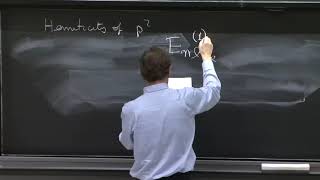
L1.1 General problem.  Non-degenerate perturbation theory
L1.1 General problem. Non-degenerate perturbation theory
2
L1.2 Setting up the perturbative equations
3
L1.3 Calculating the energy corrections
4
L1.4 First order correction to the state. Second order correction to energy
5
L2.1 Remarks and validity of the perturbation series
6
L2.2 Anharmonic Oscillator via a quartic perturbation
7
L2.3 Degenerate Perturbation theory: Example and setup
8
L2.4 Degenerate Perturbation Theory: Leading energy corrections
9
L3.1 Remarks on a 'good basis'
10
L3.2 Degeneracy resolved to first order; state and energy corrections
11
L3.3 Degeneracy resolved to second order
12
L3.4 Degeneracy resolved to second order (continued)
13
L4.1 Scales and zeroth-order spectrum
14
L4.2 The uncoupled and coupled basis states for the spectrum
15
L4.3 The Pauli equation for the electron in an electromagnetic field
16
L4.4 Dirac equation for the electron and hydrogen Hamiltonian
17
L5.1 Evaluating the Darwin correction
18
L5.2 Interpretation of the Darwin correction from nonlocality
19
L5.3 The relativistic correction
20
L5.4 Spin-orbit correction
21
L5.5 Assembling the fine-structure corrections
22
L6.1 Zeeman effect and fine structure
23
L6.2 Weak-field Zeeman effect; general structure
24
L6.3 Weak-field Zeeman effect; the projection lemma
25
L6.4 Strong-field Zeeman
26
L6.5 Semiclassical approximation and local de Broglie wavelength
27
L7.1 The WKB approximation scheme
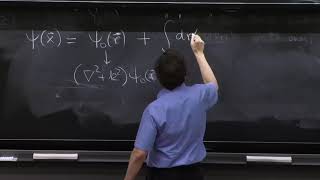
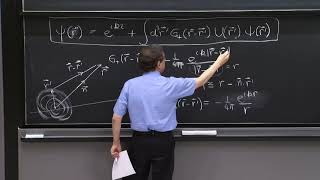
28
L7.2 Approximate WKB solutions
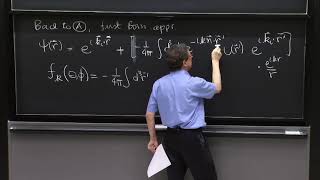
29
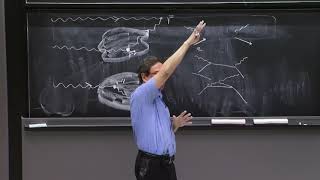
L7.3 Validity of the WKB approximation
30
L7.4 Connection formula stated and example
31
L8.1 Airy functions as integrals in the complex plane
32
L8.2 Asymptotic expansions of Airy functions
33
L8.3 Deriving the connection formulae
34
L8.4 Deriving the connection formulae (continued) logical arrows
35
L9.1 The interaction picture and time evolution
36
L9.2 The interaction picture equation in an orthonormal basis
37
L9.3 Example:  Instantaneous transitions in a two-level system
L9.3 Example: Instantaneous transitions in a two-level system
38
L9.4 Setting up perturbation theory
39
L10.1 Box regularization: density of states for the continuum
40
L10.2 Transitions with a constant perturbation
41
L10.3 Integrating over the continuum to find Fermi's Golden Rule
42
L10.4 Autoionization transitions
43
L11.1 Harmonic transitions between discrete states
44
L11.2 Transition rates for stimulated emission and absorption processes
45
L11.3 Ionization of hydrogen:  conditions of validity, initial and final states
L11.3 Ionization of hydrogen: conditions of validity, initial and final states
46
L11.4 Ionization of hydrogen: matrix element for transition
47
L12.1 Ionization rate for hydrogen:  final result
L12.1 Ionization rate for hydrogen: final result
48
L12.2 Light and atoms with two levels, qualitative analysis
49
L12.3 Einstein's argument: the need for spontaneous emission
50
L12.4 Einstein's argument: B and A coefficients
51
L12.5 Atom-light interactions:  dipole operator
L12.5 Atom-light interactions: dipole operator
52
L13.1 Transition rates induced by thermal radiation
53
L13.2 Transition rates induced by thermal radiation (continued)
54
L13.3 Einstein's B and A coefficients determined.  Lifetimes and selection rules
L13.3 Einstein's B and A coefficients determined. Lifetimes and selection rules
55
L13.4 Charged particles in EM fields: potentials and gauge invariance
56
L13.5 Charged particles in EM fields: Schrodinger equation
57
L14.1 Gauge invariance of the Schrödinger Equation
58
L14.2 Quantization of the magnetic field on a torus
59
L14.3 Particle in a constant magnetic field:  Landau levels
L14.3 Particle in a constant magnetic field: Landau levels
60
L14.4 Landau levels (continued). Finite sample
61
L15.1 Classical analog: oscillator with slowly varying frequency
62
L15.2 Classical adiabatic invariant
63
L15.3 Phase space and intuition for quantum adiabatic invariants
64
L15.4 Instantaneous energy eigenstates and Schrodinger equation
65
L16.1 Quantum adiabatic theorem stated
66
L16.2 Analysis with an orthonormal basis of instantaneous energy eigenstates
67
L16.3 Error in the adiabatic approximation
68
L16.4 Landau-Zener transitions
69
L16.5 Landau-Zener transitions (continued)
70
L17.1 Configuration space for Hamiltonians
71
L17.2 Berry's phase and Berry's connection
72
L17.3 Properties of Berry's phase
73
L17.4 Molecules and energy scales
74
L18.1 Born-Oppenheimer approximation: Hamiltonian and electronic states
75
L18.2 Effective nuclear Hamiltonian. Electronic Berry connection
76
L18.3 Example: The hydrogen molecule ion
77
L19.1 Elastic scattering defined and assumptions
78
L19.2 Energy eigenstates: incident and outgoing waves. Scattering amplitude
79
L19.3 Differential and total cross section
80
L19.4 Differential as a sum of partial waves
81
L20.1 Review of scattering concepts developed so far
82
L20.2 The one-dimensional analogy for phase shifts
83
L20.3 Scattering amplitude in terms of phase shifts
84
L20.4 Cross section in terms of partial cross sections. Optical theorem
85
L20.5 Identification of phase shifts. Example: hard sphere
86
L21.1 General computation of the phase shifts
87
L21.2 Phase shifts and impact parameter
88
L21.3 Integral equation for scattering and Green's function
89
L22.1 Setting up the Born Series
90
L22.2 First Born Approximation.  Calculation of the scattering amplitude
L22.2 First Born Approximation. Calculation of the scattering amplitude
91
L22.3 Diagrammatic representation of the Born series.  Scattering amplitude for spherically symm...
L22.3 Diagrammatic representation of the Born series. Scattering amplitude for spherically symm...
92
L22.4 Identical particles and exchange degeneracy
93
L23.1 Permutation operators and projectors for two particles
94
L23.2 Permutation operators acting on operators
95
L23.3 Permutation operators on N particles and transpositions
96
L23.4 Symmetric and Antisymmetric states of N particles
97
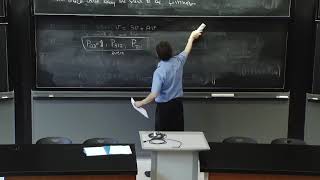
L24.1 Symmetrizer and antisymmetrizer for N particles
98
L24.2 Symmetrizer and antisymmetrizer for N particles (continued)
99
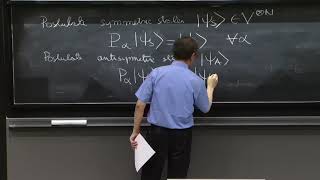
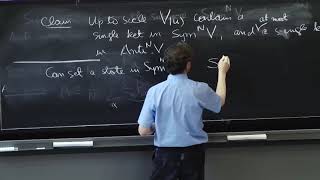
L24.3 The symmetrization postulate
100
L24.4 The symmetrization postulate (continued)