Home
學生控制台
註冊會員/登入
研究知情同意書
UeduGPTs
Aida 優學伴
Uedu Open
支援與訊息

UeduGPTs

--

Jupyters

2

AI 回覆桌面通知

AI 助教回覆完成時顯示桌面通知

聊天訊息通知

同學在討論區發送訊息時通知

聲音通知

每當有新通知時播放提示音

Uedu Open / Advanced Thermodynamics
2.43

Advanced Thermodynamics

Prof. Gian Paolo Beretta | Spring 2024
Science & Math Chemistry Physics Energy, Climate & Sustainability Energy Engineering Chemical Engineering Mechanical Engineering
前往原始課程
CC BY-NC-SA 4.0
課程簡介
This course is a self-contained concise review of general thermodynamics concepts, multicomponent equilibrium properties, chemical equilibrium, electrochemical potentials, and chemical kinetics, as needed to introduce the methods of nonequilibrium thermodynamics and to provide a unified understanding of phase equilibria, transport, and nonequilibrium phenomena useful for future energy and climate engineering technologies. Applications include second-law efficiencies and methods to allocate primary energy consumptions and CO₂ emissions in cogeneration and hybrid power systems, minimum work of separation, maximum work of mixing, osmotic pressure and membrane equilibria, metastable states, spinodal decomposition, and Onsager’s near-equilibrium reciprocity in thermodiffusive, thermoelectric, and electrokinetic cross effects.

課程資訊
來源MIT 開放式課程
科系Mechanical Engineering
語言English
影片數25
課程影片 (25)
1
Lecture 1: Definitions of System, Property, State, and Weight Process; First Law and Energy
2
Lecture 2: Second Law and Entropy; Adiabatic Availability; Maximum Entropy Principle
3
Lecture 3: Energy vs Entropy Diagrams to Represent Equilibrium and Nonequilibrium States
4
Lecture 4: Temperature, Pressure, Chemical Potentials; the Clausius Statement of the Second Law
5
Lecture 5: Definition of Heat Interaction; First and Second Law Efficiencies
6
Lecture 6: Free Energies, Available Energies, and Stability Conditions
7
Lecture 7: Availability Functions and the LeChatelier-Braun Principle
8
Lecture 8: Few versus Many Particles: The Euler Relation; Review of Various Forms of Exergy (Part I)
9
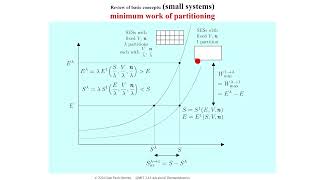
Lecture 9: Minimum Work of Partitioning Small Systems; The Gibbs Phase Rule; The Van der Waals Model
10
Lecture 10: Review of Various Forms of Exergy (Part II); Allocation of Consumptions in Cogeneration
11
Lecture 11: Allocation in Hybrid Power Production; Chemical Potentials and Partial Pressures
12
Lecture 12: Ideal Mixture Behavior; Work from Reversible Mixing; Entropy of Irreversible Mixing
13
Lecture 13: The Gibbs Paradox; Shannon Information Entropy; Single Quantum Particle in a Box
14
Lecture 14: Ideal Solution Model; Osmotic Pressure; Blue Energy; Minimum Work of Separation
15
Lecture 15: Stratification in Gas and Liquid Mixtures; Liquid-Vapor Spinodal Decomposition
16
Lecture 16: Liquid-Vapor Equilibria in Mixtures; Ideal and Excess Chemical Potentials
17
Lecture 17: Liquid-Liquid Spinodal Decomposition; Introduction to Systems with Chemical Reactions
18
Lecture 18: Properties of Reaction; Heating Values and Exergy of Fuels; Adiabatic Flame Temperature
19
Lecture 19: Affinity and Nonequilibrium Law of Mass Action; Potential Energy Surface
20
Lecture 20: Chemical Kinetics; The Arrhenius Law; Degree of Disequilibrium; Principle of...
21
Lecture 21: Introduction to Nonequilibrium Theory; Onsager Reciprocity and Maximum Entropy...
22
Lecture 22: Definition of “Heat&Diffusion” Interaction; Diffusive and Convective Fluxes
23
Lecture 23: Direct and Cross Effects; General Principles of Entropy Production; The Fourth Law
24
Lecture 24: Relative Diffusion Fluxes; Thermoelectric Effects
25
Lecture 25: Thermodiffusive Effects; Multicomponent Transport